War Games
The Politics of The 2026 World Baseball Classic Final Between USA and Venezuela

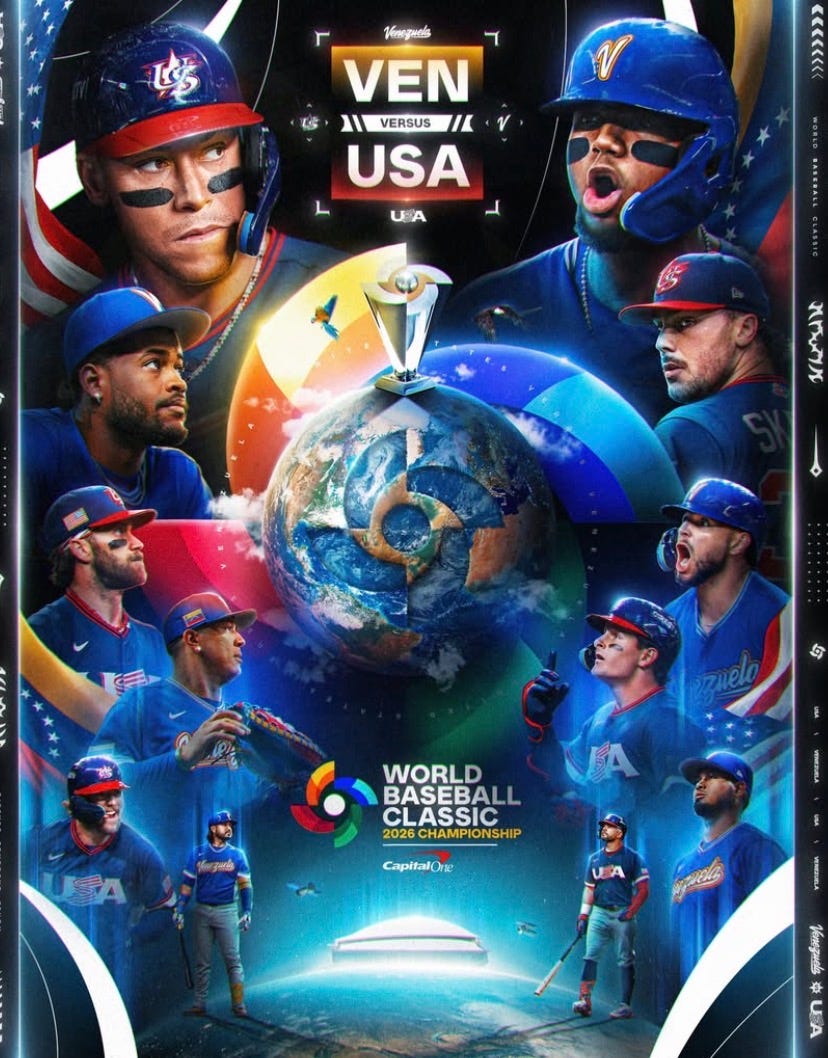
After an electric week and a half of unpredictable and exciting international baseball, the stage is set for the final round of the 2026 World Baseball Classic: USA and Venezuela, two countries that find themselves in the midst of a geopolitical chess match. Now, there is a lot of historical context that goes into the relations between these two countries, but for the brevity of this article, let’s just go over the recent events of this year, shall we?
On January 3rd, 2026, as the American people were still getting iver the New Year’s hangovers, they woke up to news headlines saying that their tax dollars just funded another illegal military operation invading a country that just so happens to be home to the largest oil reserves in the world, and arrested their president on completely bogus and made-up charges connected to “narco-terrorism,” even though 47 literally pardoned an actual drug-trafficking president from Honduras in December. Now, I do not care about how you feel about Nicholas Maduro as a leader, the USA just straight up KIDNAPPING a popularly-elected foreign leader and his wife in the middle of the night while we all sleep is objectively batshit insane. For months, I had been following the illegal extrajudicial killings of Caribbean fishermen by the U.S. for unfounded claims that these were “narcoterrorists” (a term that was literally made up as an excuse for the KKK administration to murder Caribeños), reigniting a new era of the War on Drugs that was famously a ruse for the U.S. government to vilify and criminalize the poor, Black and Brown working classes. What I am saying is that well before January 3rd, the USA was committing blatant acts of war crimes in order to strong-arm a foreign government into retaliation, and justify a ground invasion to steal these oil supplies for corporate interests. The retaliation never happened, so the federal government just took things into its own hands in an authoritarian way.
Flash forward to now, and the national baseball teams representing these two countries are now meeting to determine the winner of what is essentially the baseball equivalent of the World Cup. While the WBC has a much younger history, being only 20 years old as a competition compared to the World Cup’s nearly century-long legacy, the burning passion of fans and players representing the pride of their nations is equally matched. Well, matched by every participating country EXCEPT for the United States, which, despite being the inventors of this game, seems to have little to no charisma or interest in hyping what they perceive to be “exhibition matches.” Top-level players from almost every country spoke up on the importance of being able to bring a championship to their home country, and some players like Julio Rodriguez from the Dominican Republic, Ronald Acuña, Jr. from Venezuela, and even multiple-time World Series champion Kike Hernandez from Puerto Rico all declaring that winning the World Baseball Classic for their home country is more meaningful than winning the World Series, while the USA was moving through this tournament with an air of arrogance and non-chalance.
Starting first baseman Bryce Harper said in a press conference that the WBC is certainly great, but he seemed to shrug and brush off the opportunity to represent his country in the tournament for the first time because it’s “not the Olympics,” where “everyone will watch,” seeming to be ignorant of the fact that the last time baseball was in the Olymipcs in Tokyo 2021, it was the least watched Olympics-ever, failing to even get more than 20 million viewers in 16 of the 17 nights, meanwhile more than three times as many people watched a pool play game (not a knockout a game) between Korea and Japan in the 2023 WBC game with roughly 62 million, more viewers than any World Series game of all-time. There are levels to this shit, is what I’m saying, and Harper did not seem to get the memo.
This sense of nonimportance almost cost USA the chance to even make it to the knockout round at all, after manager Mark DeRosa wrongfully assumed they “punched their ticket” already after winning their third game against Mexico, implying that players stood up late celebrating and came into the next game against Italy a bit hungover, leading to an Italian squad made up of B and C-Tier American players with Italian heritage who were not good enough to play for Team USA and had previously not set foot in Italy before this tournament, but who understood the significance of honoring their ancestral roots as ambassadors of the game, to pull off the biggest upset in WBC history with an 8-6 win over what is on paper, the best roster of players that USA has ever assembled, featuring future hall of farmers like the aforementioned Harper, Aaron Judge, Kyle Schwarber and rising stars like Brice Turang and Cal Raleigh. Italian Team Captain Vinnie Pasquantino declared, “My family came over for a better life to America and I honestly don’t have any issue representing those members of my family… I don’t have a reason other than that: it’s cool. It’s cool being able to learn about your history and being able to perform for people in a country that baseball doesn’t exist at this level, and we’re trying to get it to exist at a level somewhat like this.”
Furthermore, while every other team has been playful and exurbaterates unadulterated passion with nods to their cultural heritage— like Italian players putting on an Armani suit and taking a shot of espresso after a home run, Japanese players stirring imaginary matcha while rounding the bases, Dominican players lifting a plantain-laden dumbbell to flex their “platano power,” or Team Puerto Rico and their fans celebrating each victory by singing the classic bolero song, “Preciosa,” the second national anthem of the island— Team USA’s playes have played this tournament with stoic faces, celebrating good plays with a simple military salute to the dugout, because apparently the only thing that Americans can think of to celebrate their country’s heritage is militarism. Starting pitcher Paul Skenes almost joined the Air Force himself before transitioning to pitching. He has also dedicated playing in the WBC to the armed forces, likening playing in this tournament to somehow being his way of “almost” serving his country as a hypothetical jet fighter dropping bombs on schools in Iran, saying, “We’re not going to war, but [this] is what we do in America: we fight and we win. That’s our responsibility.”
Prior to the semifinals between the USA and the DR, Team DR invited Hall of Fame pitcher and a pioneer for Latinos in baseball, Juan Marichal, to visit the team, connecting the past, present and future of Dominican baseball’s rich history. Who did the USA invite to stoke their feelings of national pride for a baseball tournament? A Navy SEAL Team 6 chud named Robert J. O’neill, who may or may not have actually killed Osama Bin Laden and who may or may not just be grifting for fame and wealth, but who definitely was arrested for a DUI, public intoxication and assault. Getting into the gross parasitic relationship between the U.S. military and baseball is certainly its own essay topic for another day, but regardless, while every other team is playing to represent the people of their respective countries, Team USA has been weirdly cosplaying as military expeditionists on the quest for domination over other countries. [UPDATE: Ol’ 47 himself even chimed in after Venezuela’s win in the semifinal, with a thinly veiled threat of colonizing the country as the “51st state” now that things “look great” after illegally invading the country at the start of the year.]
On the Venezuela side, the vibe has been different. These players know that shit is not sweet back home, adding to the layers of emotion for each and every game. In the last two games to even get to the final, they had come back from behind late in both games, first beating the reigning defending WBC-Champs and #1 ranked baseball nation Japan 8-5, and then knocking off the Cinderella of this year’s tournament, Italy, in a 4-2 thriller. In each of those wins, bats flipped in the air with pure ecstasy as they made their go-ahead runs, players danced in the dugout, and celebrated on the fied like they won the World Series. Team Captain Salvador Perez understands the weight of playing for his country in the midst of this political turmoil, as baseball is as much of an outlet and unifier for his country as it is a cultural export, saying, “I’m playing for my family… It’s hard for them to get a Visa to come see. I’m playing for the 30 million people back home. Even the ones who don’t like me.”
And now, whether by righteous fate or cruel irony, the final game of the 2026 World Baseball Classic is between USA, the world’s police as an imperial superpower, and Venezuela, a proud sovereign nation with its own vibrant history as a baseball superpower and an anti-imperialist stake in Latin America. While all eyes will be on the diamond tonight, the whispers of conversations in between pitches will undoubtedly be focused on the elephant-sized geopolitical landscape between the two nations. And to that, all I have to say is this:
Viva La Revolución Bolivariana.